
From Assessment to Action: A Year of Closing Oregon's Manufacturing Skills Gap
- Chris Holden
- 3 days ago
- 6 min read

A manufacturer told me recently that their hiring test for entry-level machine operators is simple: hand the candidate a micrometer and watch what happens. That alone tells them a lot about what the candidate knows and what experience they may have.
There is an old saying the micrometer makes literal: you can't improve what you don't measure. That line has been stuck in my head ever since, because it is exactly where our work starts. The manufacturer measures the candidate. We measure the region.

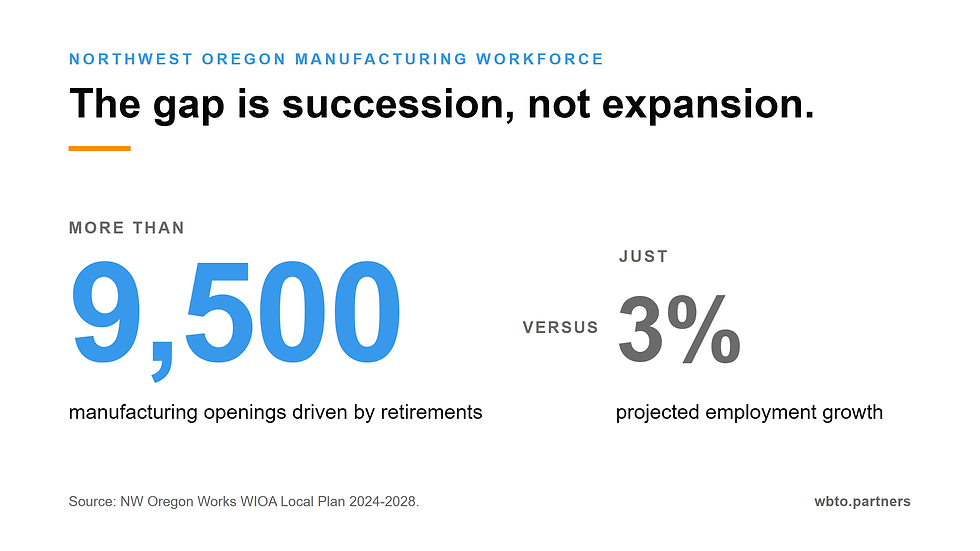
That hiring test says more about Oregon manufacturing's workforce challenge than most reports do. A generation of experienced fabricators, machinists, and tool and die makers is retiring faster than they can be replaced. In Northwest Oregon alone, the regional workforce plan projects more than 9,500 manufacturing openings driven by retirements, against just 3 percent employment growth. The gap is succession, not expansion. The people who can hold a tolerance are leaving, and the question is who replaces them.
I run WBTO, a consulting firm based in Corbett, Oregon. We work at the seams between three worlds that need each other and rarely speak the same language: manufacturers who need skilled people, the schools that could produce them, and the public workforce system that funds training. Manufacturing was the only pathway my parents talked about when I was in high school. College was never discussed.
This work is not new for us. It began taking real shape back in 2019 in southwest Washington, and my team, our partners, and I have been at it ever since: building relationships, refining the method, and earning trust one region at a time. So read what follows not as an origin story, but as a review of one year of a much longer effort, the most productive twelve months this work has had, from last November to now.
First, a quick translation
If you make things for a living, some of the alphabet soup on the education side deserves a one-line translation, because these are the people who train your future workforce.
CTE is career and technical education: the modern descendant of shop class, now teaching welding, machining, CAD, robotics, and more in high schools across the state. ESDs are education service districts, regional public agencies that support groups of school districts with services no single district could afford alone. Workforce boards, like the Clackamas Workforce Partnership, steer state and federal job-training dollars in each region. And community colleges sit in the middle, training both students and incumbent workers.
Each of these does good work. What the system lacks is connective tissue between them, and between all of them and you. That is the gap WBTO has spent years learning to fill.
Measure the gap, skill by skill
It starts with measurement. We call it a Regional Needs Assessment: I sit down with a region's manufacturers and ask, skill by skill, what they actually expect of an entry-level hire. Then we visit the high school shops, look at the equipment, and talk with the instructors about what students can actually do by graduation. The distance between those two answers, measured skill by skill and school by school, is the region's real gap. Not a vibe, a number. We are measuring alignment: what students can actually do, against the spec employers actually set.
We have now run that same assessment in four Oregon regions: Columbia County, Clackamas County, Lane County, and currently across Clatsop, Columbia, and Tillamook counties for the Northwest Regional Education Service District. Same method everywhere, so regions can be compared honestly.
This year we extended the measurement statewide. We classified every Oregon CTE program at the course level: 1,130 programs, 14,714 courses, 269 schools. The result surprised even me. Oregon has 399 manufacturing-relevant CTE programs, but only about 91 carry the Manufacturing label. The other 308 are filed under Automotive, Agriculture, Engineering, and other categories in the state's system. Nearly half of the state's welding courses live outside the Manufacturing category entirely.

We also published exactly how accurate that classification is, because I believe a small firm's analysis earns trust by stating its numbers, never by asserting its quality. Validated against a region we labeled by hand, the classifier reached a precision of 1.00 and recall of 0.92. When it says a school teaches a sector, it was right every time in that test.
The lesson underneath: program labels lie, courses tell the truth. Any region planning its workforce pipeline from labels alone is undercounting its own classrooms roughly three to one. If you are a manufacturer who assumed there is no training program near you, there is a real chance you are wrong, and we can probably show you where it is.
Build the room, then keep it
Measurement only matters if someone acts on it. After our Clackamas County assessment, the partners there did something I wish every region would do: they formed a coalition and kept meeting. It is called AMRAC, the Advanced Manufacturing Regional Action Coalition, and this year it became an institution.
In November we convened AMRAC at Clackamas Community College's industrial technology center. On May 27 we held the fifth Clackamas County convening at the Clackamas Education Service District, alongside the South Metro-Salem STEM Partnership, Clackamas Community College, and the Clackamas Workforce Partnership: nearly 30 partners, manufacturers, shop teachers, college faculty, economic development staff, and state workforce leaders in one room, talking specifics.
The room is where the real economy shows up. Benchmade noted it had the only successful tool and die apprentice in Oregon last year. A welding instructor told the employers present, "What you throw away, I get ten times more use out of." One rural program is full and would need roughly $2 million to expand to meet student demand, a reminder that growing student interest is not always matched with investment.
And the room produces decisions. This May, AMRAC agreed to serve as a standing advisory committee for area CTE programs, giving instructors the committed industry voice they struggle to assemble one school at a time. Two districts decided to stop trying to do everything alone: Estacada will anchor machining, CNC, and CAD while Molalla becomes the welding hub, with their first shared student cohort planned for next year. Manufacturing Day at Clackamas Community College has grown from 314 registered students in 2022 to 888 attending in 2024.

The proof that this loop works is now several years deep. The 2023-24 Clackamas assessment helped bring about $75,000 in donated equipment and four modernized school shops.
What a year of listening taught me
Train first, then equip. A machine without an instructor who can run it becomes a very expensive paperweight. I have seen donated equipment sit idle for lack of training, and I have seen one focused day of in-shop instructor coaching unlock more student capability than a new purchase.
The most urgent needs are often too small for big grants. Scrap steel, welding wire, electrodes, booth lighting: a few thousand dollars that no major grant program covers. That is why I committed, in the room on May 27, to build a central grant-resource hub for CTE instructors, one place to find the funding that fits the size of the actual problem.
Recurring beats one-off. Instructors do not need new faces at every meeting; they need committed advisory structures and repeat industry volunteers. Standing coalitions outperform annual summits.
Align, don't duplicate. We split internship outreach with the Clackamas Workforce Partnership by sector so employers only get one ask. We coordinate company visits with county economic development for the same reason. And we design our assessments to feed state data efforts rather than compete with them. Nobody in this ecosystem has time for turf.
What's next
Our Northwest Oregon assessment is in its final stages, and the method is expanding beyond machining and welding into wood products and food manufacturing, the region's largest manufacturing employers. The American Manufacturing & Workforce Innovation Collaborative, a nonprofit our partners are standing up to channel funding toward the needs the region identifies, seated its founding board this spring. AMRAC reconvenes this fall. And Manufacturing Day returns to Clackamas Community College on October 2.
If you are a manufacturer: your scrap, your tours, and one recurring hour a month in a classroom are worth more than you think, and they cost you almost nothing. Reach out and I will connect you to the program nearest you.
If you are an educator: tell me what is actually in your way. The smaller and more specific, the better. That is exactly what the grant-resource hub is being built for.
We have been building toward this since 2019. What changed this past year is that the work stopped looking like a series of reports and started looking like infrastructure: a standing coalition, a comparable measurement method, and a growing list of fixed, specific problems. That is what I mean by assessment to action.

Chris Holden is the founder of WBTO, LLC, a consulting firm working at the intersection of manufacturing, education, and workforce development across the Pacific Northwest. Reach him at chris@wbto.partners or visit wbto.partners.
Comments